The single biggest mistake we see on Hamilton sites is treating anchors as a generic off-the-shelf item. A contractor pulls a standard tendon assembly from inventory, installs it in the Queenston shale or Halton till without a site-specific load test, and then wonders why the lock-off load drops 30% within a week. It is not the anchor. It is the ground. Hamilton sits between the Niagara Escarpment and the deep glacial lake deposits of the former Lake Iroquois. Shale bedding planes dipping south create asymmetric stress relief. Anchor design here must account for that anisotropy. Our team applies instrumented proof testing on sacrificial anchors before production drilling even begins. For deep cuts near the escarpment face, we often integrate slope stability analysis during the anchor design phase to confirm the global failure surface does not bypass the bonded length entirely.
An anchor is not a commodity. In Hamilton’s escarpment geology, the difference between a design that holds and one that creeps is a site-specific proof test before production drilling begins.
Methodology applied in Hamilton
Demonstration video
Typical technical challenges in Hamilton
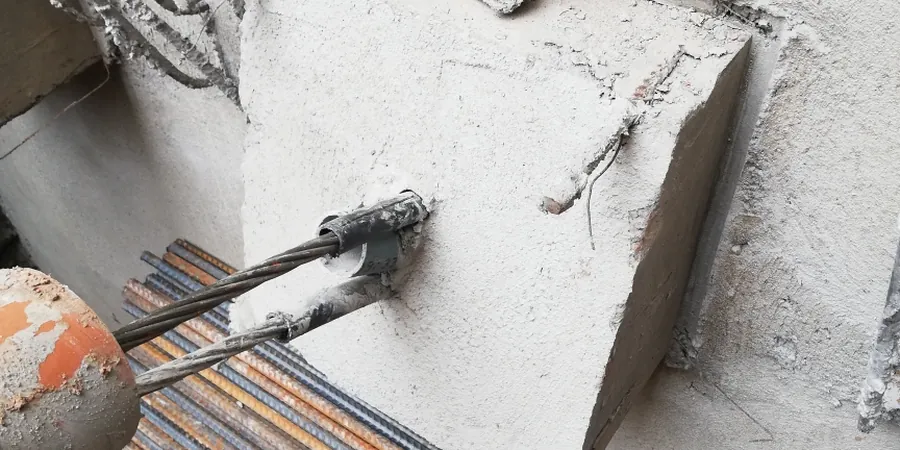
The biggest risk in a city built on the escarpment is tendon corrosion plus bond decay acting together. Hamilton gets about 900 mm of precipitation a year, and road salt in winter pushes chlorides deep into the fill above the weathered rock. We have extracted anchors after only eight years of service where the strand was reduced to 60% of its original cross-section right at the bond–free length transition. That is the critical zone. Our corrosion protection spec includes a corrugated HDPE sheath over the full free length, a minimum 15 mm grout cover in the bond zone, and a sealed trumpet transition at the bearing plate. On one James Street North project, the owner initially declined DCP for passive anchors to save cost. We pushed back with a lifecycle cost analysis comparing a 30-year repair scenario versus the upfront premium for encapsulated tendons. The numbers convinced them. In Hamilton’s soil and weather, a non-protected anchor is a deferred liability.
Our services
Anchor design in Hamilton is never a copy-paste exercise. The escarpment geology demands three distinct service phases, delivered in tight coordination with the shoring contractor.
Anchor Feasibility and Tender Design
We review the geotechnical baseline report, identify potential bond zones in the Halton till or Queenston Formation, and produce a preliminary anchor layout with estimated free and bond lengths. The deliverable is a design report suitable for permit submission to the City of Hamilton.
On-Site Proof Testing and Performance Verification
Before production drilling, we run sacrificial anchor tests to verify ultimate bond stress. Each test anchor is instrumented with a load cell and tell-tales to measure load distribution along the bonded length. We adjust the design based on actual ground response, not textbook values.
Long-Term Monitoring and Lift-Off Testing
For permanent anchors, we set up a monitoring schedule with periodic lift-off checks. A hydraulic jack re-engages the anchor, and we measure the load at which the wedge plate lifts off the bearing plate. Any loss beyond 5% triggers an investigation and possible re-stressing.
Frequently asked questions
What does active/passive anchor design cost for a typical Hamilton excavation?
Design fees for a tied-back excavation in Hamilton generally range from CA$1,260 to CA$4,970, depending on the number of anchor rows, the complexity of the ground profile, and whether the anchors are temporary or permanent. A simple three-row temporary system in competent shale falls at the lower end. A permanent multi-row scheme with double corrosion protection in variable till over fractured rock, requiring sacrificial testing and load cells, moves toward the upper end.
How deep can you anchor into the Queenston shale?
Bonded lengths in Queenston shale typically range from 6 to 12 meters, but the controlling factor is not depth alone: it is the spacing and persistence of bedding-plane joints. We measure recovered core from the anchor hole and run water-pressure tests in the bond zone. If the Lugeon value exceeds 10, the grout will simply leak into open joints and the anchor will not develop full capacity. In those cases, we extend the bond length or switch to a post-grouted system.
Are passive anchors enough for an excavation near a heritage building?
Rarely. Passive anchors mobilize force only after the wall deforms. A heritage masonry structure on shallow footings, common along streets like James or MacNab, cannot tolerate that movement. We specify active prestressed anchors for the upper rows, stressed to lock off immediately after the grout reaches 25 MPa, so the wall does not move at all. The passive anchors may be added at lower levels where deformation is less critical.