Hamilton sits at the western tip of Lake Ontario, and while the seismic hazard here is moderate compared to British Columbia, the deep glacial and lacustrine sediments in the lower city amplify ground motion in ways that standard fixed-base design doesn't always capture well. NBCC 2020 places Hamilton in a seismic zone where spectral accelerations at 0.2 s and 1.0 s can govern mid-rise and essential facilities, especially on the Queenston Shale transition and the soft soils near the harbour. Base isolation cuts that demand at the source: we decouple the superstructure from ground motion using lead-rubber bearings or triple-pendulum isolators designed to the site-specific spectra. A proper isolation design starts with the geotechnical profile, and in Hamilton we often pair the isolator design with a seismic microzonation study to capture variations in Vs30 across the escarpment and the lakeshore plain. The goal is a period shift that moves the structure well away from the dominant 1–2 Hz energy typical of eastern Canadian events, while controlling displacement at the isolation interface within the NBCC drift limits.
In Hamilton's lower city, base isolation doesn't just reduce seismic force—it controls the differential settlement that soft lacustrine clays would otherwise amplify during shaking.
Methodology applied in Hamilton
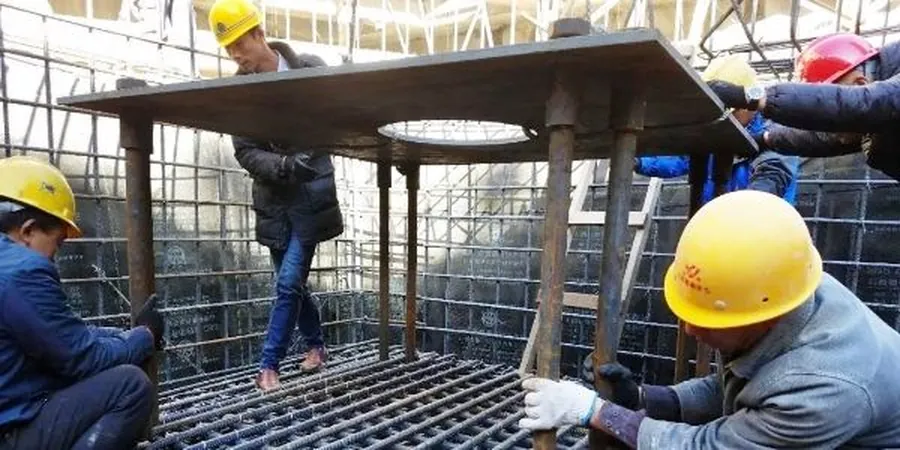
Typical technical challenges in Hamilton
What we see repeatedly in Hamilton is that the isolation gap—the physical space around the structure that allows it to move—gets underestimated when the geotechnical report only provides generic site class without a measured Vs30 profile. On the deep clay of the former marshlands near Cootes Paradise, the amplification at long periods can push displacement demands 15–20 percent above the code-default values, and if the moat wall or utility connections aren't detailed for that extra travel, you get pounding or service line rupture. Another recurring issue is the vertical component of near-field eastern earthquakes; lead-rubber bearings are vertically stiff, and on highly compressible soil that vertical stiffness can transfer more axial load fluctuation into the foundation than the structural engineer expects. We always insist on a paired CPT test and shear-wave velocity profile so the isolator designer has a defensible set of soil springs, and we check the residual settlement under the maximum considered earthquake because post-event releveling of an isolated building on clay is far more complex than on rock. Ignoring the soil-isolator interaction in Hamilton's lower city is the single most expensive shortcut a project can take.
Our services
Our base isolation work in Hamilton covers the full cycle from feasibility to testing oversight. Each project gets a ground-motion suite tailored to the site's Vs30 and basin effects, not just a generic Class C spectrum.
Nonlinear time-history analysis
We select and scale 11 ground-motion pairs to the NBCC 2020 uniform hazard spectrum, matching both the 0.2 s and 2.0 s spectral ordinates so the isolator period range is properly excited.
Isolator specification and testing oversight
From bearing diameter and lead-core size to the prototype test matrix per CSA S832 Annex A, we prepare the specification package and witness the full-scale tests at the manufacturer's lab.
Soil-structure interaction modeling
We build the impedance functions for the foundation—spread footings, pile groups, or mat—so the isolation model reflects the real flexibility of Hamilton's variable subsurface, not a fixed-base assumption.
Frequently asked questions
What does base isolation design cost for a typical Hamilton project?
For a mid-rise structure in Hamilton, the combined geotechnical site characterization, nonlinear time-history analysis, isolator specification, and testing oversight typically ranges from CA$5,110 to CA$10,830, depending on the number of ground-motion pairs, the complexity of the soil profile, and the isolator prototype test scope.
Does NBCC 2020 require base isolation for Hamilton buildings?
NBCC 2020 does not mandate base isolation for any specific building type, but for post-disaster structures, essential facilities, and high-importance buildings, the code's higher performance factors often make isolation the most economical way to meet drift and force limits, especially on Hamilton's soft lakebed soils.
How does the Niagara Escarpment affect isolation design?
The escarpment creates a sharp contrast in foundation stiffness: rock within a few metres on the mountain versus deep clay below the escarpment. This affects the isolator period, the displacement demand, and the foundation spring values we input into the structural model, so we always run separate analyses for upper and lower city sites.
What isolator types work best in Hamilton's soil conditions?
Lead-rubber bearings work well on the shale and limestone of the mountain because the stiff substructure keeps the period shift predictable. In the lower city's soft clay, friction pendulum systems provide more flexibility to accommodate longer periods and larger displacements without increasing the bearing diameter excessively, though they require careful detailing for the vertical load path.