The most expensive mistake we see in Hamilton tunneling isn't a TBM getting stuck. It's a contractor relying on regional geology maps instead of face-specific logging through the Queenston Shale contact. The Red Hill Valley Parkway project taught us that the transition from glaciolacustrine silts to weathered shale happens over meters, not kilometers. In the Lower City, high groundwater at 1.5 m depth turns silty clay into flowing ground instantly. We've worked on collector sewers where the face conditions changed three times in a single shift. Standard borehole spacing misses these transitions. Our approach combines continuous sampling ahead of the face with real-time CPT testing to map pore pressure dissipation before the cutterhead advances into trouble. When the alignment crosses under the escarpment, we also specify slope stability analysis because the tunneling-induced settlement can reactivate ancient landslide blocks in the Eramosa Member.
In Hamilton's Lower City, the groundwater is the tunnel alignment. Control the pore pressure or the pore pressure controls your schedule.
Methodology applied in Hamilton
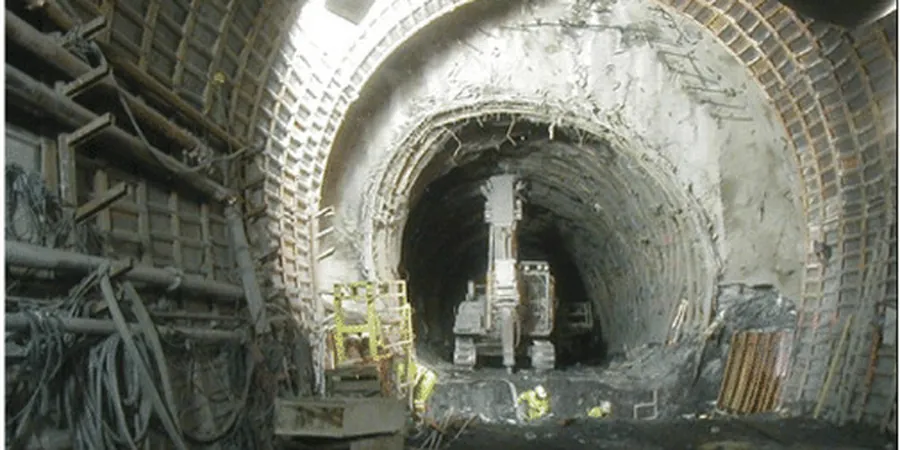
Typical technical challenges in Hamilton
Hamilton's population of 570,000 relies on a combined sewer network, much of it installed before 1910 and now being upsized with tunneled interceptor relief. The biggest geotechnical risk isn't the soft clay. It's the unrecorded backfill in the historic creek ravines that were buried and built over. The old Arkledun and Sherman ravines were filled with everything from brick rubble to industrial slag, and this anthropogenic fill extends 6-9 m deep. Tunnel boring through this material without a pre-excavation investigation invites catastrophic loss of face and surface settlement exceeding 100 mm. Our pre-construction investigations map these buried valleys using a grid of test pits and dynamic cone penetration to define the fill-bedrock interface. We also assess the risk of clogging in the TBM cutterhead. The glaciolacustrine clays have Atterberg limits that plot above the A-line, meaning they're high-plasticity and sticky. Without the correct slurry conditioning specified from our laboratory index testing, the spoil becomes a plastic plug that stalls production for hours. That's a direct cost to the contractor's cycle time.
Our services
Our Hamilton tunnel investigations follow a phased approach that matches the project's risk profile. We don't run a standard suite of tests and hand over a PDF. We design the investigation around the specific face stability, groundwater, and settlement constraints of your alignment.
Face Stability & Support Pressure Design
We calculate EPB face support pressures using the wedge and chimney stability models from Anagnostou & Kovari (1996), calibrated with our site-specific undrained shear strength profiles from CPT soundings. We specify the pressure gradient along the alignment, not just a single target value.
Settlement Trough & Building Damage Assessment
Using the Gaussian trough method and volume loss parameters back-calculated from Hamilton's previous tunnel projects, we predict surface settlements and angular distortion for every structure within the influence zone. We classify damage risk per Burland (1997) categories 0 through 5.
Pre-Excavation Borehole & Fill Mapping
We target the buried ravine fills with a dense grid of dynamic cone penetrometer soundings and hollow-stem auger borings. We log the anthropogenic fill/glacial deposit contact and install standpipe piezometers to define the pre-tunneling groundwater profile. Data feeds directly into the TBM readiness checklist.
Frequently asked questions
What's the typical cost range for a pre-tunnel geotechnical investigation in Hamilton?
Depending on the tunnel length, number of boreholes, and laboratory testing program, a project-specific investigation for a soft ground tunnel in Hamilton generally ranges from CA$5,900 to CA$23,520. Shorter microtunnels with a single face condition fall on the lower end, while longer drives crossing the Lower City-Mountain transition with multiple stratigraphic units require more extensive sampling and testing.
How do you handle the groundwater in Hamilton's Lower City for EPB tunneling?
We install vibrating wire piezometers at multiple depths to measure the hydrostatic profile before the drive. The key is determining whether the Halton Till acts as a continuous aquitard separating the upper and lower aquifer systems. If it's discontinuous, we design the EPB conditioning to create a low-permeability filter cake at the face, preventing uncontrolled groundwater inflow and maintaining face pressure.
What is the biggest geotechnical challenge for tunneling under the Niagara Escarpment in Hamilton?
The transition from soft glaciolacustrine clay to the weathered Queenston Shale at the escarpment base. The shale contains swelling clay seams that can heave when exposed to air and water in the cutterhead chamber. We sample these seams specifically for x-ray diffraction to quantify the smectite content, then specify a dry cutting procedure and immediate shotcrete sealing for the portion of the drive in the transition zone.
Can you predict building settlement before the TBM passes underneath?
Yes, using the volume loss method calibrated to Hamilton's geology. We model the transverse settlement trough for each sensitive structure along the alignment. The angular distortion and horizontal strain are calculated and compared against the limiting tensile strain of the building's construction type—masonry, steel frame, or concrete. We provide a pre-condition survey baseline and real-time trigger levels for the TBM guidance system.