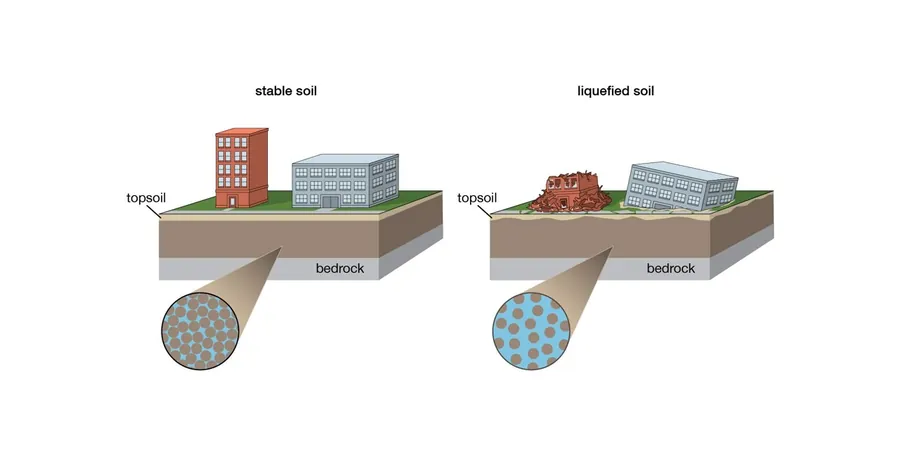
The ground response differs sharply between the bedrock-controlled slopes of the Escarpment and the deep lacustrine clays near the harbour. On the Mountain, you hit shale at 2 metres; down by Barton Street, you can drill 30 metres and stay in saturated silt. That contrast defines liquefaction risk in Hamilton—a city of 570,000 where the former Glacial Lake Iroquois left layered deposits that behave very differently under seismic shaking. We run site-specific analyses because a generic seismic classification tells you nothing about what happens at 6 metres depth in a layer of loose hydraulic fill. Before mobilizing a drill rig, we often pair the investigation with SPT drilling to get blow counts every 1.5 metres, and in silty zones we add CPT testing for continuous tip resistance and friction ratio profiles that catch thin layers SPT might miss.
Liquefaction doesn't require a magnitude 9 event. A moderate M5.5 at 15 km depth can mobilize loose saturated silts in Hamilton’s filled zones.
Methodology applied in Hamilton
Demonstration video
Typical technical challenges in Hamilton
A 10-storey residential project on King Street East encountered loose saturated silt at 4 metres, directly below the footing influence zone. The initial design assumed a bearing capacity of 180 kPa on compacted fill, but our CPT profiles showed a 2-metre-thick layer with qc values under 3 MPa and friction ratios above 2.5%—classic liquefiable behaviour. Without analysis, the structure would have met code for static load but failed the seismic deformation check. We calculated a lateral spreading displacement of 180 mm toward the adjacent right-of-way, which exceeded the 75 mm serviceability limit in the geotechnical brief. The fix involved stone columns on 2-metre spacing through the loose layer, followed by a compacted granular pad. Post-treatment SPT testing confirmed N1(60) values above 20, pushing the factor of safety above 1.3 for the design earthquake. That’s the difference between a performant foundation and a future insurance claim.
Our services
The liquefaction assessment scope depends on the site class, structure importance category, and depth of the critical layers. We deliver three core packages:
Screening-Level Liquefaction Assessment
Desktop review using existing borehole data, geological mapping, and groundwater records. We compute the cyclic stress ratio and factor of safety for critical layers and deliver a go/no-go recommendation. Suitable for preliminary site acquisition and due diligence.
Full Field Investigation and Analysis
SPT and CPT program with sampling for grain-size and Atterberg limits. We run the simplified procedure with site-specific PGA, produce liquefaction potential index (LPI) maps, and estimate post-liquefaction settlement and lateral spreading. Includes a mitigation feasibility discussion.
Mitigation Design and Verification
Design of ground improvement—stone columns, vibrocompaction, or deep soil mixing—to achieve target post-treatment N1(60) or qc1N values. We supervise the trial zone, run CPT verification testing, and issue a signed compliance report for the building permit submission.
Frequently asked questions
What does a soil liquefaction analysis cost for a typical Hamilton site?
For a standard commercial or multi-residential lot in Hamilton, budget between CA$3,400 and CA$5,900. The range covers the field investigation (SPT or CPT), laboratory grain-size testing, and the engineering report with factor of safety calculations and settlement estimates. Larger or more complex sites with deep liquefiable layers or multiple boreholes will exceed the upper end.
Which areas in Hamilton have the highest liquefaction risk?
The highest risk zones are the filled lands along Hamilton Harbour, the lower city areas with shallow groundwater (less than 2 m depth), and former creek valleys that were infilled during industrial development. The Mountain, underlain by shale bedrock at shallow depth, has negligible liquefaction potential except in isolated pockets of overburden.
When does the NBCC require a site-specific liquefaction analysis?
NBCC 2020 triggers a site-specific analysis for Site Classes E and F, or when the site is in a moderate-to-high seismic zone and the structure is Importance Category 3 or 4 (schools, hospitals, emergency facilities). The code also requires it when loose saturated sands or silts are encountered within the top 15 metres and the water table is within 5 metres of grade—conditions common in lower Hamilton.