A six-storey mixed-use project on King Street East ran into refusal at 4 meters—glacial till compacted like concrete. The contractor had skipped preliminary boreholes, assuming limestone bedrock was deeper. That single oversight cost three weeks of idle equipment and a redesign of the foundation system. In Hamilton, the subsurface tells a story shaped by the Niagara Escarpment, ancient Lake Iroquois deposits, and industrial fill along the harbour. A properly executed Standard Penetration Test cuts through the guesswork. We mobilize truck-mounted or track-mounted rigs depending on access constraints, and every SPT drilling operation follows ASTM D1586-18 with a safety hammer calibrated to 60% energy efficiency. The N-values we record—whether in the soft Queenston Shale or the dense Halton Till—provide the empirical backbone for bearing capacity calculations under the National Building Code of Canada.
Hamilton's glacial stratigraphy demands more than textbook correlations—N-values from Queenston Shale and Halton Till behave differently, and local experience interpreting refusal is what prevents over-designed foundations.
Methodology applied in Hamilton
Beyond the raw N-value, we correct for overburden pressure and hammer energy following Seed's methodology, producing N₁₆₀ values that feed directly into liquefaction assessments and seismic microzonation studies required by Hamilton's planning department for taller structures.
Typical technical challenges in Hamilton
The most frequent mistake we see in Hamilton is treating the upper 1.5 meters of weathered crust as representative bearing stratum. A builder runs a few shallow dynamic cone tests, gets decent resistance, and pours footings at that depth—only to discover the underlying saturated silt loses strength dramatically during spring thaw. The SPT reveals that transition because the split-spoon sampler captures the actual soil fabric at each 1.5-meter interval. In the lower city, where water tables sit within 2 meters of grade and historic creek beds were filled during the 20th century, undocumented organic layers or loose backfill can compress differentially under load. Skipping proper CPT testing or SPT boreholes on a commercial slab in those zones has led to settlements exceeding 50 millimeters within the first year. A single SPT borehole to 15 meters costs a fraction of the repair work on a tilted floor slab. For the harbourfront brownfields, we also recommend liquefaction assessment using NCEER methodology whenever the SPT encounters loose saturated sands below the water table—a scenario that's more common than many developers expect in Hamilton's east-end industrial parcels.
Our services
Our Hamilton SPT program is backed by a laboratory accredited to ISO 17025 for soil classification testing. Every borehole log includes field moisture estimates, consistency descriptions, and colour notation using the Munsell system—details that matter when correlating across a site.
SPT Drilling & N-Value Logging
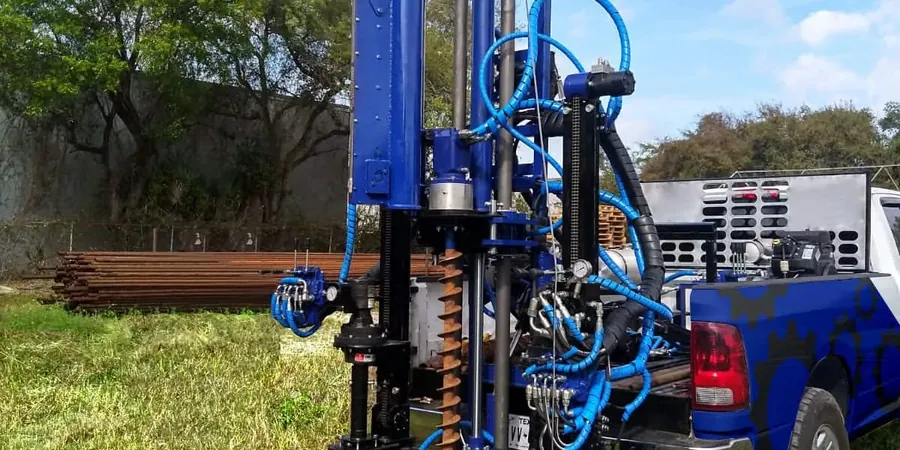
Truck-mounted or limited-access track rigs performing ASTM D1586-18 SPT at 1.5 m intervals. Each split-spoon sample is visually classified on site, with representative samples sealed for laboratory index testing. We provide corrected N₁₆₀ values alongside raw blow counts.
Laboratory Classification Suite
Samples recovered from the SPT split-spoon are tested for grain size distribution (sieve and hydrometer), Atterberg limits, and natural moisture content. This data confirms field classifications and feeds directly into bearing capacity and settlement analyses under NBCC guidelines.
Foundation Parameter Reporting
We deliver a factual geotechnical report with N-value profiles, interpreted stratigraphy, and derived parameters including relative density, consistency, and friction angle estimates. For projects requiring numerical modeling input, we also provide constrained modulus ranges calibrated to local Hamilton formations.
Frequently asked questions
What is the typical cost of an SPT investigation in Hamilton?
For most Hamilton projects, SPT drilling ranges from CA$660 to CA$1,140 per borehole depending on depth, access constraints, and whether you need a truck-mounted or portable rig. A commercial building on a standard downtown lot with two boreholes to 15 meters would generally fall in the CA$2,500–CA$3,800 range, including the factual report with N-values and soil descriptions.
How do Hamilton's escarpment soils affect SPT N-values?
The Niagara Escarpment geology creates sharp transitions. In the upper Mountain area, the Halton Till—a dense, silty clay with stones—produces N-values often exceeding 50 at relatively shallow depths. Down in the lower city, the glacial lake sediments and Queenston Shale can show N-values below 10 in the upper layers before hitting competent material. Our interpretation accounts for these local stratigraphic markers rather than applying generic correlations from southern Ontario manuals.
How many boreholes do I need for my building permit application in Hamilton?
Hamilton's building department typically requires a minimum of one borehole per 300 m² of building footprint for structures under Part 4 of the Ontario Building Code, with a minimum of two boreholes for any project. For irregular sites or those near the escarpment hazard zone, we recommend three or more to capture lateral variability. We coordinate directly with your structural engineer to position boreholes where column loads will be highest.