Hamilton sits at roughly 100 meters above lake level on the western tip of Lake Ontario, where the Niagara Escarpment cuts right through the city and exposes Queenston Shale, dolostone, and glacial till in dozens of road cuts and construction sites. Every excavation deeper than a few meters here intersects materials whose strength depends heavily on confinement, pore pressure, and loading rate—variables that only a well-designed triaxial program can isolate properly. Our team has run consolidated-undrained and unconsolidated-undrained triaxial tests on samples pulled from the Barton Street corridor, the Red Hill Valley, and the infill zones near the harbour, giving us a dataset that ties lab-measured cohesion and friction angle directly to Hamilton’s actual stratigraphy. When a shallow footing design or a slope cut in the Dundas area needs reliable effective-stress parameters, we run the specimens through saturation, consolidation, and shear stages following ASTM D4767-11, reporting c’ and φ’ values that feed straight into limit-equilibrium models without guesswork.
A single stage of consolidated-undrained triaxial testing on Halton Till typically yields a friction angle between 28° and 34°, but the real engineering value lies in the excess pore-pressure curve that tells you whether the material will drain or trap water during rapid loading.
Methodology applied in Hamilton
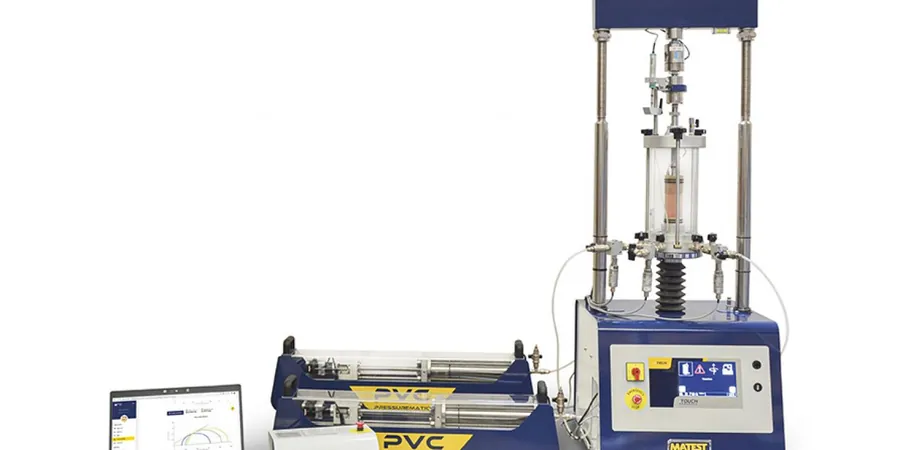
Typical technical challenges in Hamilton
Hamilton’s industrial east end and the downtown core expanded during the steel-boom decades on land that was often recontoured with fill of unknown provenance—slag, ash, demolition debris, and dredged harbour sediment. When a developer proposes a mid-rise on a former brownfield site near Wellington Street North, the geotechnical baseline can shift from competent till to 4 meters of uncontrolled fill in the space of a single borehole. Relying on SPT blow counts alone in those conditions misses the critical distinction between a fill that dilates under shear and one that collapses as pore pressure spikes. A consolidated-undrained triaxial test with pore-pressure measurement reveals exactly that behaviour: we’ve seen effective friction angles drop from 33° to below 20° in saturated slag fill when sheared undrained, a warning sign that a conventional bearing-capacity calculation would simply miss. The Canadian Foundation Engineering Manual (4th edition) explicitly recommends triaxial testing for critical structures on soft or variable ground, and for Hamilton sites within the seismic design category D per NBCC 2015, the post-cyclic shear strength from triaxial data becomes a non-negotiable input to any defensible liquefaction assessment.
Our services
The triaxial test is the central element of a shear-strength characterization program, but it’s rarely run in isolation. The four complementary services below cover the full workflow from sample recovery to design-parameter delivery for Hamilton projects.
Consolidated-Undrained Triaxial (CU) with Pore-Pressure Measurement
The workhorse test for Hamilton’s saturated tills and clays. Specimens are consolidated to the estimated in-situ effective stress, then sheared undrained while we record excess pore pressure. Effective-stress Mohr-Coulomb parameters c’ and φ’ are delivered with Skempton’s A-parameter at failure, ready for slope-stability and foundation models.
Consolidated-Drained Triaxial (CD) for Granular and Compacted Fills
Applied to sands, gravels, and compacted shale fill from Niagara Escarpment borrow sources. The slow shear rate ensures zero excess pore pressure throughout, yielding drained friction angles that govern long-term stability of embankments and retaining structures along the Red Hill and Lincoln Alexander parkways.
Unconsolidated-Undrained Triaxial (UU) for Rapid Assessment
A quick total-stress test used during early-stage site investigation in Hamilton’s brownfield corridors. Provides undrained shear strength su for cohesive fill and intact clay layers, useful for preliminary bearing-capacity checks and excavation-sidewall stability before a full CU program is commissioned.
Multi-Stage Triaxial Testing on a Single Specimen
When recovered Shelby-tube samples are limited—common in Hamilton’s boulder-rich tills—we run multiple confining-stress stages on one specimen. Each stage ends just before failure, conserving material while still producing a three-point Mohr envelope. ASTM D4767 procedures are adapted with careful strain control to avoid cumulative damage.
Frequently asked questions
What is the typical cost range for a triaxial test program in Hamilton?
A standard three-specimen consolidated-undrained triaxial test program in Hamilton generally falls between CA$2,300 and CA$3,330, depending on the number of confining-stress stages, specimen preparation complexity, and whether drained or multi-stage protocols are required. The price includes saturation, consolidation, shear, and a report with Mohr-Coulomb parameters. Projects involving difficult-to-trim tills or requiring expedited turnaround may sit at the upper end of that range.
How does the triaxial test differ from a direct shear test for Hamilton soils?
The direct shear box forces failure along a predetermined horizontal plane, which can be useful for residual-strength measurements on polished shale surfaces from the Queenston Formation. The triaxial test, by contrast, allows the specimen to fail along its weakest orientation under controlled drainage and confining stress. For Hamilton’s overconsolidated Halton Till, triaxial CU tests routinely give friction angles 2° to 5° higher than direct shear on the same material, but the key advantage is the pore-pressure record—direct shear cannot measure excess pore pressure during undrained shearing, so it cannot separate total-stress from effective-stress behaviour.
How many triaxial tests are needed for a typical Hamilton mid-rise project?
A defensible program for a mid-rise building on glacial till in Hamilton usually requires a minimum of three CU triaxial tests per distinct soil unit, each at a different confining pressure, to define the Mohr-Coulomb envelope. If the borehole logs reveal two or three distinct strata—say, upper fill, Halton Till, and a deeper glaciolacustrine clay—then nine specimens across those units is a common starting point. The exact number depends on site variability and the consequence class of the structure per NBCC.
What sample quality is required for a reliable triaxial test?
The test is only as good as the sample. For CU and CD triaxial testing we require undisturbed specimens obtained with a Shelby tube or piston sampler, trimmed to 50 mm diameter with minimal disturbance. Hamilton tills often contain cobbles that can score the tube and compromise specimen integrity; in those cases we log the disturbance class per ASTM D4220 and may downgrade data interpretation accordingly. Highly disturbed samples are better suited to UU testing or to a recompacted program where we reconstitute specimens to target density and moisture.