In Hamilton, where heavy clay soils and glacial till dominate the landscape, the Proctor test remains the primary reference for compaction quality. ASTM D698 and D1557 define the method, but local conditions along the Niagara Escarpment and the city’s industrial waterfront demand more than just a standard curve. The team runs both Standard and Modified Proctor tests on material sourced directly from the project site, because the correlation between moisture content and dry density shifts significantly across Hamilton’s micro-geologies. The city, home to over 560,000 people and built on a mix of shale bedrock and lacustrine sediments, requires a nuanced approach to earthworks. Understanding the maximum dry density and optimum moisture content is non-negotiable before placing fill under a roadway or a slab. For granular materials, the complementary sand cone density test verifies field compaction against the lab target. Specs from the Ontario Provincial Standards and the City of Hamilton engineering guidelines routinely reference these curves, and the lab calibrates every test to the specific compactive effort required by the structural design.
A Proctor curve generated without site-specific soil is just a textbook exercise—what matters is the curve that reflects the actual fill material going under the compactor.
Methodology applied in Hamilton
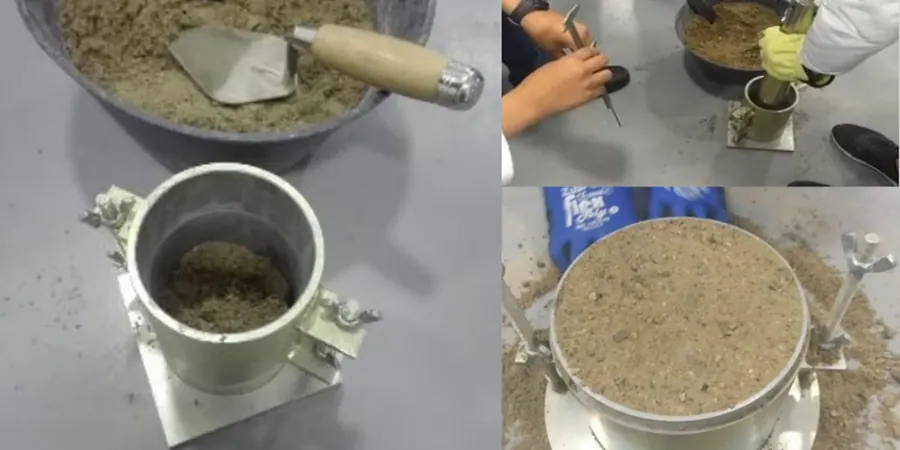
Typical technical challenges in Hamilton
Hamilton sits at about 75 meters above lake level, but its real geotechnical risk lies in the variability of its soils over short distances. A 2021 slope failure on the escarpment near the Sherman Access underscored how water infiltration into poorly compacted fill can trigger instability. When a contractor skips the Proctor test and relies on visual judgment, the consequences are predictable: settlement under floor slabs, asphalt rutting after the first freeze-thaw cycle, or differential movement in approach embankments. The city’s humid continental climate, with over 900 mm of annual precipitation, means moisture control is a constant battle. A proper compaction curve gives the site supervisor a clear target—optimum moisture content and maximum dry density—so the roller operator knows exactly what to chase. Without it, overcompaction wastes fuel and shatters aggregate, while undercompaction leaves voids that invite water and future distress. The Proctor test is not a bureaucratic formality; it is the cheapest insurance against a failed density test and a rejected lift.
Our services
The lab provides compaction testing services tailored to the typical soil profiles encountered across the Greater Hamilton Area, from Ancaster to Stoney Creek.
Standard Proctor (ASTM D698)
Compaction curve for residential subdivisions, landscaping, utility trenches, and low-rise commercial pads where conventional equipment is used.
Modified Proctor (ASTM D1557)
Higher compactive effort curve for highways, heavy industrial floors, airport pavements, and deep fill projects requiring maximum density.
One-Point Proctor Verification
Quick field check to confirm that the borrow material still matches the original lab curve, useful for long-duration earthworks where source material changes.
Frequently asked questions
What is the difference between Standard and Modified Proctor in simple terms?
The Standard Proctor uses a 5.5 lb hammer dropped 12 inches to simulate lighter compaction equipment. The Modified Proctor uses a 10 lb hammer dropped 18 inches to replicate the energy of heavy vibratory rollers. The Modified test produces a higher maximum dry density and a lower optimum moisture content. The choice depends on the project specification: most structural fill under buildings uses Standard, while highway base courses and airport pavements call for Modified.
How much does a Proctor test cost in Hamilton?
A Standard or Modified Proctor test typically ranges from CA$130 to CA$310 per sample, depending on whether it is a full multi-point curve or a single-point verification, and whether oversized particle corrections are needed. The price reflects the lab time required to dry, process, compact, and plot the material across several moisture contents.
How long does it take to get results from a Proctor test?
A standard turnaround is 24 to 48 hours after the sample arrives at the lab. The soil must be dried, processed, and then compacted at four or five different moisture contents. Each point requires mixing, compacting in the mold, weighing, and taking a moisture sample. Rush service can deliver results the same day if the sample arrives early and the lab schedule permits.
Do I need a new Proctor test if the soil on site changes?
Yes. The Proctor curve is material-specific. If the fill changes from a brown silty clay to a grey clayey silt, the optimum moisture content and maximum dry density will shift. Running a new test on the different material ensures the field density test is compared against the correct reference. Continuing with the old curve leads to false passes or false failures during compaction inspection.