Hamilton's subsurface is a direct product of the Niagara Escarpment, where the overburden transitions sharply from stiff glacial till of the Halton Formation to the fractured shale and dolostone of the Eramosa and Lockport members. In the lower city, you might encounter 3 to 4 meters of fill overlying 8 to 12 meters of soft, compressible lacustrine clay before reaching bedrock, while the mountain brow demands immediate engagement with near-surface rock and the potential for wedge failures controlled by joint sets. Designing a deep excavation here means we are constantly reconciling the high horizontal stresses locked into the Paleozoic bedrock with the practical limits of urban shoring—often within a few meters of century-old brick foundations. The depth to groundwater varies dramatically depending on which side of the escarpment you are on, which directly dictates whether we design a fully tanked structure or can rely on perimeter drainage. A thorough cone penetration test becomes essential when navigating the soft clay pockets near the harbour, helping us model undrained shear strength profiles for temporary slope cuts.
In Hamilton, the difference between a successful deep dig and a costly delay often comes down to how well you predicted the groundwater flow through fractured bedrock.
Methodology applied in Hamilton
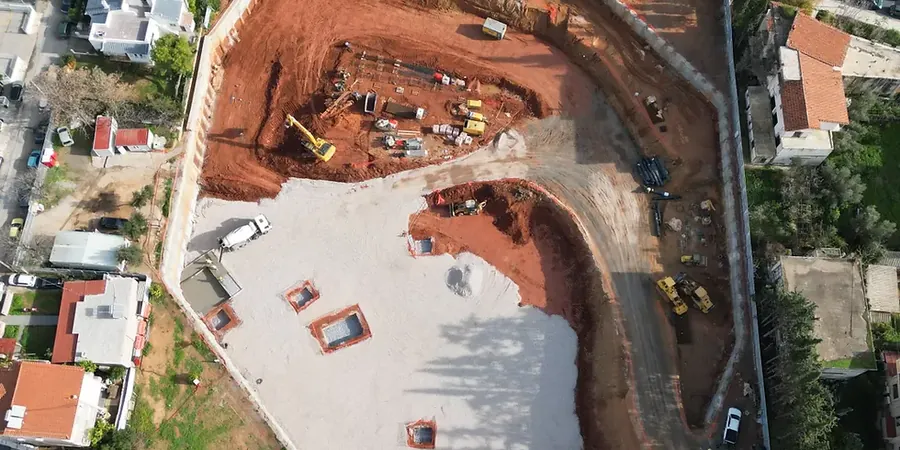
Typical technical challenges in Hamilton
The risk profile for a deep excavation on the mountain brow versus the lower city near the bay is fundamentally different, even though they are only a few kilometers apart. Up on the escarpment, the primary hazard is rockfall and structurally controlled block release from the face, which can propagate into a global stability issue if the excavation undercuts a critical joint set dipping toward the cut. Down by the harbour, the fight is against basal heave in the soft glaciolacustrine clays; if the undrained shear strength is below 25 kPa, the factor of safety against bottom uplift can drop below 1.2 unless we deepen the wall or install jet grout struts below the subgrade. Across both zones, the proximity to Red Hill Creek or Chedoke Creek tributaries introduces a hydraulic connection that can overwhelm dewatering systems if not properly modeled. We consistently find that ignoring the weathered, rubbly top of the Queenston Shale—treating it as competent rock when it behaves like a stiff soil—is the single most common cause of over-excavation and wall movement in Hamilton projects.
Our services
A deep excavation design in Hamilton's varied geology requires a suite of integrated services that go far beyond selecting a shoring wall section. We deliver complete packages that address the specific challenges of the escarpment and the harbour basin.
Staged Excavation Analysis & Shoring Design
We develop fully sequenced 2D and 3D finite element models calibrated with site-specific geotechnical parameters. The design output includes full structural calculations for soldier pile and lagging systems, secant or contiguous pile walls, internal bracing layouts, and tie-back anchor geometry, with every element checked against the limit states in CSA S6-19 and local Hamilton building code amendments for deep foundations and temporary works.
Dewatering and Groundwater Control Plans
Drawing on hydrogeological data from the fractured Niagara Escarpment formations, we design dewatering systems ranging from deep well arrays in dolostone to vacuum-assisted wellpoints in silty clay. Each plan includes predicted inflow rates, settlement impact assessments on neighboring structures, and a monitoring trigger plan to activate contingency cut-off measures if groundwater levels deviate from the model.
Frequently asked questions
What is the typical cost range for geotechnical design of a deep excavation in Hamilton?
Professional fees for a complete deep excavation design package in Hamilton typically range from CA$3,140 to CA$12,680, depending on the excavation depth, complexity of the shoring system, and whether the site is on the escarpment brow or in the lower city clay plain. A straightforward secant wall design for a 6-meter cut will be at the lower end, while a fully instrumented, staged rock excavation with tie-back anchors and comprehensive groundwater modeling falls at the higher end.
How does the Niagara Escarpment affect deep excavation design in Hamilton?
The escarpment introduces near-surface bedrock with strong horizontal stress fields and distinct joint sets that control rock mass behavior. On the mountain brow, we design for wedge and toppling failures along persistent discontinuities in the Lockport Dolomite, while below the escarpment face, the excavations are often in the softer Queenston Shale, which degrades quickly when exposed and can swell, requiring immediate shotcrete sealing and solid drainage behind the wall.
What shoring systems are most appropriate for Hamilton's soft harbour clays?
In the deep lacustrine clay deposits near Hamilton Harbour, secant pile walls or sheet pile cofferdams with internal bracing are generally the most reliable options. The key challenge is preventing basal heave; we often extend the wall toe into the underlying glacial till or bedrock to cut off deep-seated failure surfaces, and in critical cases we specify jet grout bottom plugs to control uplift pressures during excavation.
Do you need a retaining wall permit for a deep excavation in Hamilton?
Yes, any excavation deeper than 1.2 meters that is within the angle of repose from a property line or public right-of-way requires a shoring permit from the City of Hamilton Building Division. The design must be stamped by a Professional Engineer licensed in Ontario and demonstrate compliance with the Ontario Building Code Part 4, including a pre-construction condition survey of adjacent buildings and a monitoring plan for vibration and settlement.
How do you handle groundwater during deep excavations near Hamilton's creeks?
Excavations near Red Hill Creek, Chedoke Creek, or the harbourfront require a hydrogeological model that accounts for both the porous overburden and the fracture flow in the bedrock. We typically install a combination of perimeter deep wells and, where the excavation cuts into dolostone, angled drain holes to depressurize water-bearing joints. Continuous monitoring of pore pressures with vibrating wire piezometers allows us to adjust pumping rates in real time and protect against piping erosion at the excavation base.