Hamilton's geotechnical profile is dominated by Halton Till, a dense silty clay deposit overlying Queenston Shale. The Red Hill Valley and parts of the lower city also feature deep lacustrine clay layers with high plasticity. Designing a shallow foundation here means confronting variable bearing strata and a shallow water table that fluctuates seasonally near the harborfront. A standard prescriptive footing width won't cut it in Ward 3 where the clay can soften significantly after excavation. Our approach pairs site-specific bearing capacity calculations with settlement analysis under NBCC 2015 load combinations. For lots with marginal near-surface soils, we often integrate ground improvement review before finalizing the stone columns layout to reduce differential settlement beneath continuous footings.
Bearing capacity in Hamilton's Halton Till often exceeds 150 kPa at 1.5 m depth, but settlement control governs the design in 80% of our projects.
Methodology applied in Hamilton
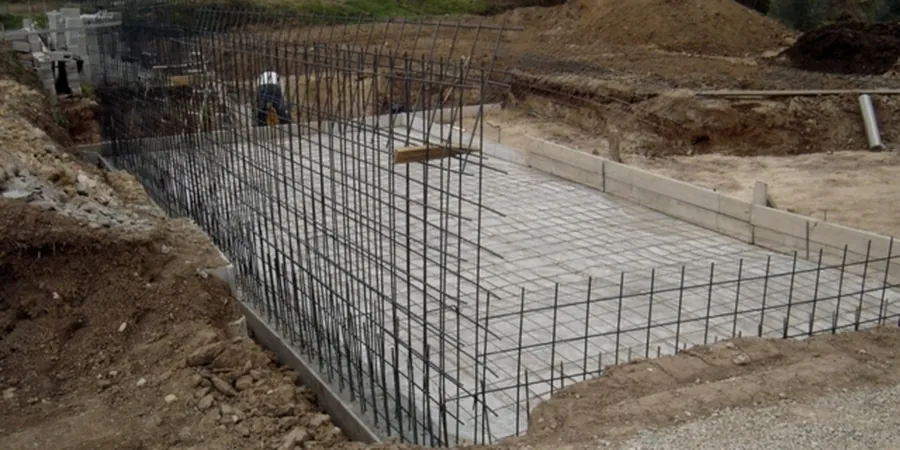
Typical technical challenges in Hamilton
A three-story mixed-use building on Main Street West started experiencing step cracking in the block walls eight months after occupancy. The investigation revealed differential settlement of 25 mm between interior and exterior footings. The culprit: uncontrolled backfill around the perimeter that settled after compaction, combined with a strip footing design that assumed uniform bearing conditions across the entire pad. Hamilton's heterogeneous glacial till doesn't read the textbook. A footing bearing on a stiff till pocket can sit 3 meters from one resting on a softer silt lens. Our risk mitigation protocol requires test pit logging at every footing location for irregular sites, plus a specified subgrade inspection window before concrete placement. We also model total settlement under sustained dead load plus a fraction of live load, not just net bearing pressure.
Our services
We deliver practical shallow foundation solutions for Hamilton projects, from single-family infill lots to commercial buildings. Every design package includes a stamped geotechnical report with excavation recommendations, bearing pressure tables, and subgrade preparation specs.
Bearing Capacity & Settlement Analysis
Footing and mat foundation design using SPT data, lab consolidation tests, and in-situ shear strength. We provide allowable bearing pressures for serviceability and ultimate limit states per NBCC.
Subgrade Preparation & Frost Protection
Specifications for proof-rolling, mud-mat placement, and insulation requirements where frost depth exceeds excavation depth. Includes recommendations for dewatering during construction.
Frequently asked questions
How deep do footings need to be in Hamilton?
Minimum 1.2 m below finished grade for frost protection per the Ontario Building Code. Deeper if organic soils or fill are present, or if bearing on competent till requires additional embedment.
What is the typical allowable bearing pressure for footings on Halton Till?
We typically recommend 150 kPa for strip footings at 1.5 m depth on undisturbed, unweathered Halton Till. Values drop to 75-100 kPa in softened upper till zones or where silt content increases.
How much does a shallow foundation design report cost in Hamilton?
A standard shallow foundation design package for a single-family or small commercial building in Hamilton ranges from CA$2,840 to CA$4,310, depending on the number of boreholes, lab testing scope, and foundation complexity.
Can I use a shallow foundation on Hamilton's red shale bedrock?
Yes, Queenston Shale provides excellent bearing capacity for shallow foundations. However, the rock surface can be irregular, and the upper weathered zone must be removed. A site investigation confirming refusal depth and rock quality is essential.