A seven-storey mixed-use building on King Street East encountered a subsurface profile that shifted from stiff clay till to weathered shale within less than forty metres, a condition we see frequently across lower Hamilton where the bedrock surface mirrors the paleo-topography of the buried Niagara Escarpment. The structural engineer had specified a conventional spread footing until our investigation revealed differential settlement would exceed tolerable limits under the east wing. By reworking the foundation concept around bored cast-in-place piles socketed into competent Queenston Formation shale, the design team eliminated the settlement risk and gained enough lateral capacity to resist the wind loads that funnel through the Dundas Valley. This type of site-specific intervention is what defines effective pile foundation design in a city where the average annual freeze-thaw cycle penetrates nearly a metre into the ground, and where the seismic site class can jump from C to D across a single property line depending on the thickness of the glaciolacustrine blanket.
Socketing piles into the Queenston shale demands a design that accounts for both the intact rock strength and the frequency of near-horizontal bedding-plane separations.
Methodology applied in Hamilton
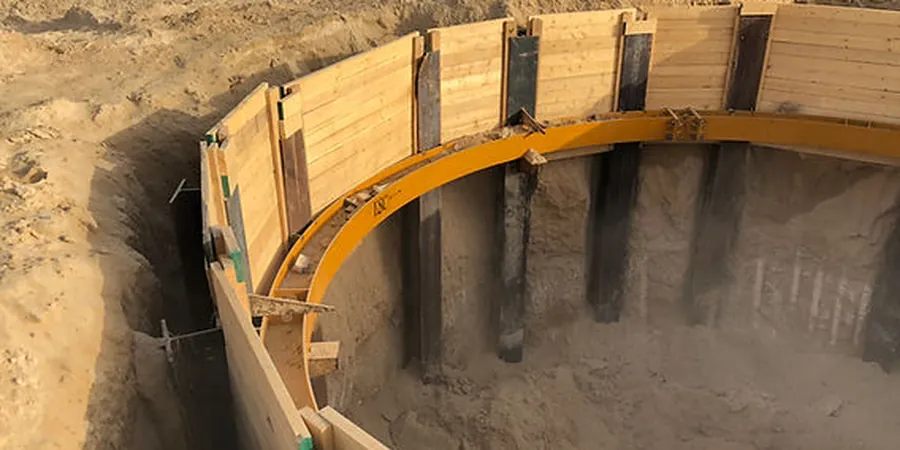
Typical technical challenges in Hamilton
One pattern that keeps resurfacing in Hamilton is the misclassification of weathered shale as stiff clay during preliminary logging, which leads to pile designs that are terminated short of competent rock and later exhibit unacceptable settlement under sustained dead load. The upper two to three metres of the Queenston Formation are frequently degraded to a clayey consistency with slickensided fracture surfaces, and only a point-load test or careful refusal monitoring during drilling can distinguish this material from the true glacial till above it. Another recurring issue involves open-ended pipe piles driven through the harbour fill, where obstructions such as buried timber cribs and slag from the historic steel mills can deflect the pile tip or cause premature refusal that is mistaken for bedrock. Our team routinely specifies pilot-hole drilling ahead of pile installation in these areas and correlates the driving records with nearby borehole data to confirm that the design capacity is being achieved in the intended bearing stratum.
Our services
Pile foundation design in Hamilton draws on a range of specialized services that address the local geology and regulatory environment. Each component is calibrated to the site-specific ground conditions encountered across the Golden Horseshoe.
Geotechnical Investigation for Deep Foundations
We execute borehole programs using hollow-stem auger and HQ wireline coring to characterize the overburden stratigraphy and bedrock quality beneath your site. The investigation provides the undrained shear strength profiles, rock quality designation logs, and groundwater monitoring data required for pile capacity calculations under CFEM methods.
Axial and Lateral Pile Capacity Analysis
Our analysis integrates site-specific soil and rock parameters to compute shaft friction and end-bearing components for both driven and drilled piles. For sites near the Red Hill Valley or other slope-influenced corridors, we include lateral load analysis using p-y curve methods to verify performance under wind and seismic demands per NBCC 2020.
Frequently asked questions
What is the typical cost range for pile foundation design for a residential project in Hamilton?
For a single-family home or small commercial building, pile foundation design services in Hamilton typically range from CA$2,170 to CA$8,580, depending on the number of boreholes, the depth to competent rock, and whether static load testing is required by the building permit office.
How deep do piles need to go to reach competent rock in Hamilton?
It varies significantly by location. In the lower city near the harbour, piles may extend 30 to 50 metres to reach the Queenston Formation shale. On the Mountain brow, competent rock is often encountered within 10 to 15 metres. We determine the exact depth through a site-specific drilling investigation that logs the bedrock quality and RQD.
Does pile design in Hamilton need to account for seismic loading?
Yes. Hamilton is located in a region of moderate seismicity, and the NBCC 2020 requires seismic design for all structures. The site class — determined by the shear wave velocity of the upper 30 metres — can range from C to E depending on the drift thickness, which directly influences the spectral acceleration values used in the foundation design.
What type of pile is most suitable for the clay soils near the harbour?
In the deep glaciolacustrine clays around Hamilton Harbour, bored cast-in-place piles with temporary casing are often the most reliable choice because they can be drilled through soft zones without causing ground loss and can be inspected at the base before concreting. Driven H-piles are also used but require careful splice design to reach the deep rock surface.