Hamilton straddles two worlds: the flat, sedimentary plains of the lakefront and the fractured, sloping bedrock of the Niagara Escarpment. One road section might sit on glacial till while another rests on Queenston shale. This geological divide demands a rigid pavement design approach that goes far beyond a standard cross-section. A concrete slab that performs well on Stoney Creek clay can fail catastrophically below the Mountain brow if the subgrade reacts differently to moisture and frost. We combine the CBR road test for subgrade characterization with precise modulus of rupture values to model slab behavior, ensuring the pavement structure works with the local geology rather than against it.
A rigid pavement design in Hamilton lives or dies by its joint detailing and subbase drainage—the concrete mix is the easy part.
Methodology applied in Hamilton
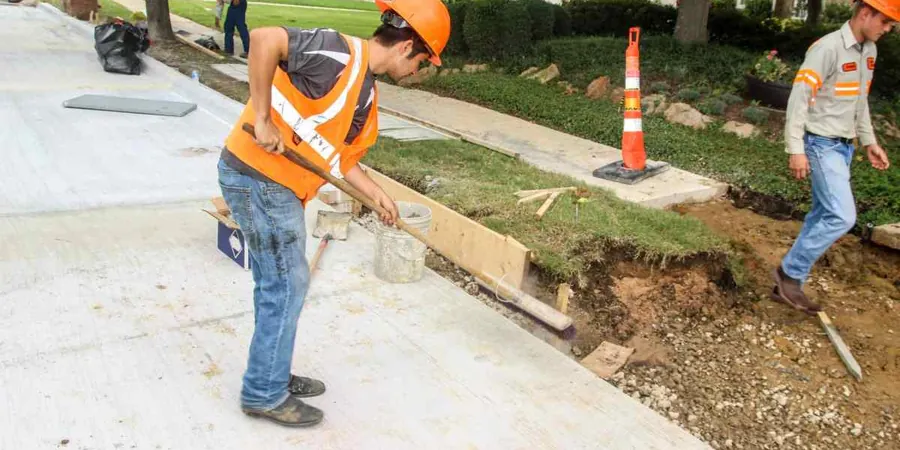
Typical technical challenges in Hamilton
The most common error in Hamilton is treating the entire site as a single subgrade condition. A contractor will assume uniform support, only to find that the transition zone between shale bedrock and glacial till creates differential settlement within the first two winters. The pavement slabs crack at the dowel bars, water infiltrates, and the freeze-thaw cycle widens the fractures into spalls. Another recurring problem is specifying a standard dowel diameter without considering the port traffic loads—standard 32 mm dowels can yield under repeated 80 kN single-axle loads if the concrete bearing stress is not checked. Our rigid pavement design protocol includes a site-specific Westergaard edge-load analysis and a seasonal k-value correction based on in-situ moisture data, preventing these failures before the first concrete truck arrives.
Our services
A rigid pavement design package for a Hamilton project requires several coordinated geotechnical inputs. The following services build the technical foundation for the slab design.
Subgrade Support Characterization
We determine the modulus of subgrade reaction (k-value) through plate load tests or correlation with CBR values, adjusted for seasonal moisture in Hamilton's silty clay tills.
Concrete Mix Performance Testing
Flexural beam testing per ASTM C78 and freeze-thaw durability assessment per CSA A23.2-24A to confirm the mix can survive 30+ years of Hamilton winters.
Joint Pattern and Load Transfer Design
Detailed joint layout plans showing dowel bar diameters, tie bar spacing, and isolation joint locations at structures and manholes, based on ACPA guidelines.
Drainage and Subbase Design
Design of the granular subbase and edge drains to maintain a stable moisture regime beneath the slab, critical for the poorly draining soils near the Red Hill Valley.
Frequently asked questions
Why choose rigid pavement over flexible pavement for a Hamilton industrial parking lot?
For heavy, channelized traffic like dump trucks or container haulers, rigid pavement resists rutting and shoving far better than asphalt. The concrete slab distributes loads over a wider area, reducing stress on Hamilton's variable subgrades. It also eliminates the recurring maintenance cost of resurfacing asphalt in high-traffic zones.
What is the typical rigid pavement design cost range for a project in Hamilton?
A complete rigid pavement design package, including subgrade investigation, k-value determination, and jointing plan, generally falls between CA$2,840 and CA$7,410. The final cost depends on the number of borings, the length of pavement analyzed, and whether MEPDG modeling is required.
How do you account for the Niagara Escarpment's fractured shale in the design?
We map the bedrock surface across the site using test pits or borings. Where the depth to shale is less than 1.5 meters, we specify a thicker granular sub-base to bridge any differential movement at the soil-rock interface. The design also includes a separation geotextile to prevent fines migration into the fractured rock.
What joint sealant performs best in Hamilton's climate?
We specify silicone-based sealants for transverse contraction joints because they maintain elasticity through the full temperature range, from -25°C winter nights to 35°C summer afternoons. Hot-pour sealants tend to become brittle and lose adhesion within five to seven years in this freeze-thaw environment.