Hamilton sits at about 75 meters above the lake, but the real story is underground. The city’s industrial east end and expanding suburbs north of the Niagara Escarpment sit on thick deposits of loose, water-laid sands—some zones with SPT blow counts below 10. That’s a problem when you need to place heavy crane pads, storage tanks, or mid-rise structures on compressible ground. We’ve seen too many projects stall because the soil report came back with a “remediate or rethink your foundation” note. Vibrocompaction design turns that around: it’s a deep densification method that rearranges sand grains into a tighter, stronger matrix, right where they sit. In Hamilton’s lakeshore silty sands, pairing vibrocompaction with a thorough CPT test program lets us verify density gains in real time, and we often cross-check results with grain size analysis to confirm the soil will respond as expected.
Vibrocompaction doesn’t just densify—it rearranges the soil fabric so that loose, liquefiable sand becomes a competent bearing layer without importing massive volumes of fill.
Methodology applied in Hamilton
- Target relative density (typically 70–85% for most Hamilton commercial pads)
- Triangular or square grid layout with spacing based on probe influence radius and CPT calibration
- Energy and amperage criteria to confirm refusal or adequate compaction at each point
- Post-treatment verification plan, often combining CPT soundings, SPT checks, and occasional geophysical cross-checks
- Settlement estimates under service loads to satisfy the Ontario Building Code’s serviceability limits
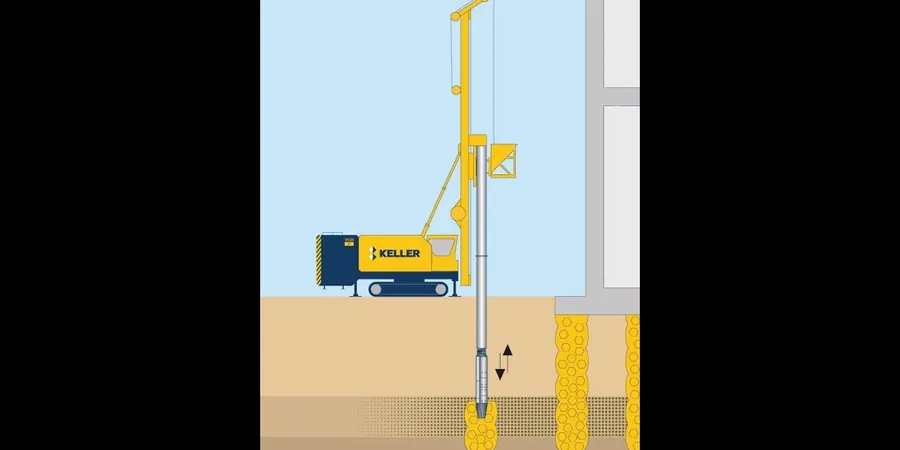
Typical technical challenges in Hamilton
A contractor near the Red Hill Valley Parkway called us after their pad for a pre-engineered building started showing differential settlement before the slab was even poured. The initial geotech report had flagged “possible loose zones” but didn’t mandate deep ground improvement. They poured a mud slab and hoped for the best—within six weeks they had cracks running diagonally across the floor. We back-analyzed the CPT logs and the vibrocompaction design that should have been there from day one: an 8-foot triangular grid, two passes per point, and a minimum cone tip resistance of 12 MPa post-treatment. Skipping vibrocompaction in Hamilton’s loose lakeshore sands doesn’t just risk settlement—it invites liquefaction concerns under seismic loading, especially for sites classified as Site Class D or E under the NBCC. Once the slab is poured and equipment is bolted down, remediation costs can triple.
Our services
Our vibrocompaction design work in Hamilton usually involves three distinct phases, each shaped by the specific soil conditions and structural demands of the project. We don’t do cookie-cutter grid layouts.
Pre-Treatment Site Characterization and CPT Calibration
Before we touch a vibroflot, we need to know the soil’s grain size distribution, fines content, and in-situ density. A series of CPT soundings and select mud rotary borings give us the baseline profile. We correlate cone tip resistance to relative density using published charts (Baldi, Jamiolkowski) and adjust for Hamilton’s typical silty sand overburden. This phase sets the density target and confirms the soil is vibro-suitable.
Vibrocompaction Grid Design and Energy Specification
We develop the probe configuration, step interval, and hold time at each depth. For a 15-meter treatment depth in Barton Street area fill, that might mean a 2.4-meter triangular grid with a 160 kW vibroflot, stepping every 0.5 meters, holding until amperage stabilizes. We specify the water pressure and flow rate for jetting, and define refusal criteria so the operator knows when the sand has packed tight enough.
Post-Treatment Verification and As-Built Reporting
After treatment, we run a series of CPT soundings at centroids and grid intersection points to confirm the target tip resistance has been achieved. If any soft spots remain, we localize re-treatment. The final report includes settlement estimates under design loads, liquefaction trigger analysis (using NCEER methodology adapted to CPT data), and a signed Letter of Assurance for the Hamilton building department.
Frequently asked questions
How much does vibrocompaction design and treatment typically cost for a Hamilton commercial lot?
For a standard commercial pad in Hamilton—let’s say 800 to 2,000 square meters—you’re usually looking at a total project range of CA$2,100 to CA$7,260 for the design, field supervision, and post-treatment verification package. The actual treatment cost depends on depth, grid spacing, and access conditions, but design and QA/QC typically fall within that window for most industrial and mid-rise residential sites in the Greater Hamilton Area.
Is vibrocompaction effective in Hamilton’s silty sands near the lake?
It depends on the fines content. Clean sands densify beautifully with vibrocompaction. When silt content climbs above 15–20%, the water jets can’t drain fast enough and the soil won’t repack efficiently. We always run grain size and Atterberg limits first. If the material is too silty, we might shift the design toward stone columns or a combined approach, but for the classic loose beach sands along Hamilton Harbour, vibrocompaction is our go-to.
How long does the vibrocompaction process take from design to verification?
Design and calibration usually take one to two weeks, including the pre-treatment CPT campaign. The treatment itself moves fast—a two-person crew with a crawler crane and vibroflot can treat 200 to 400 square meters per day depending on depth and grid density. Post-treatment verification adds another two or three days. For a typical Hamilton industrial lot, you’re looking at a three- to four-week window from mobilization to final QA report.
Does vibrocompaction eliminate liquefaction risk under the Ontario Building Code?
When designed and verified correctly, vibrocompaction can move a site from NBCC Site Class D or E up to Class C, which significantly reduces or eliminates the liquefaction potential for the design earthquake. We run post-treatment CPT data through the NCEER methodology (Youd and Idriss, 2001) to calculate factor of safety against liquefaction. If the numbers check out and the building official is satisfied, you’re in good shape—no deep foundations needed.