Hamilton sits right where the Niagara Escarpment cuts across the city, and that geology defines every retaining wall we design here. You can drive from the mountain brow down to the lower city and the soil profile changes completely in a few hundred meters; the upper bench gives you Queenston shale and dolostone within reach of a backhoe, while the lower city sits on thick glaciolacustrine deposits and silty clays that lose strength fast when they get wet. We run in-situ permeability tests early in the design phase because perched groundwater in the Halton Till is a recurring problem along the escarpment face, and a wall that looks fine on paper can fail if you ignore the seepage patterns. The Hamilton market has seen enough slope failures along the brow to know that a retaining structure must account for both the static load and the seasonal pore pressure buildup.
A retaining wall on the Hamilton escarpment is not a standard precast block job; it is a structure that has to manage 50 metres of slope gradient above it and a wet freeze-thaw cycle every spring.
Methodology applied in Hamilton
- bedding orientation matters more than the unconfined compressive strength
- we log joint spacing and dip direction in every borehole because a daylighting joint plane can reduce passive resistance to near zero
- when the wall is close to a property line we often combine anchors with a soldier pile system instead of relying purely on mass concrete
Demonstration video
Typical technical challenges in Hamilton
A wall on the mountain brow near the Kenilworth access and a wall down in the Dundas valley wetlands deal with completely different failure mechanisms. Up top, the risk is a wedge failure along a weathered shale bedding plane that nobody spotted during the site investigation; we have seen cases where a perfectly adequate reinforced concrete cantilever rotated forward because the passive wedge in front of the toe was sliding on a slickensided surface. Down in the lower city, the battle is with soft, compressible silts that can settle unevenly under a gravity wall, cracking the stem and letting water in. That is why we tie grain-size curves and consolidation data directly to the wall type selection: a mechanically stabilized earth wall might tolerate more differential settlement than a rigid gravity structure, but only if the backfill is properly graded and the reinforcement length is not cut short to save space.
Our services
Our lab on the Hamilton mountain handles the full workflow from undisturbed sample to final design parameter report, so the wall design is always backed by soil data from the actual site, not just textbook correlations.
Cantilever and gravity wall design
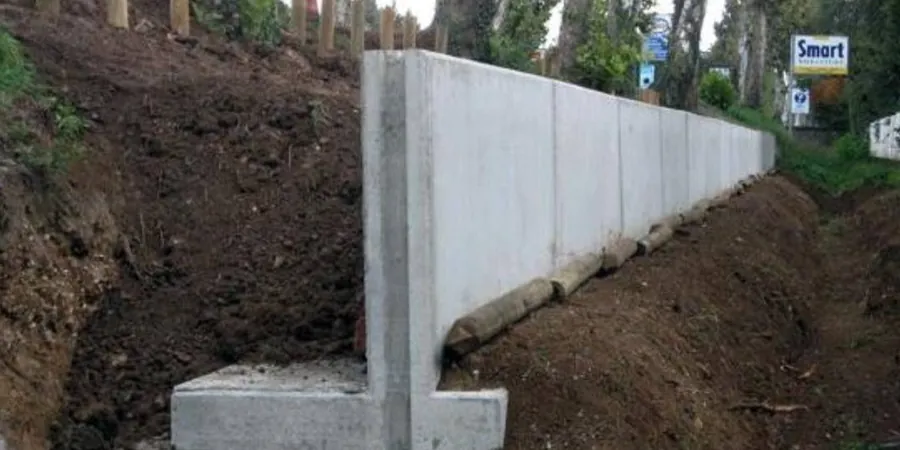
Reinforced concrete and mass gravity sections sized for the backfill and foundation conditions encountered in the Halton Till and Queenston shale, with overturning and sliding checks per CFEM.
MSE wall and anchored systems
Mechanically stabilized earth walls using galvanized steel or geogrid reinforcement, and post-tensioned anchor design for tied-back soldier pile walls along tight property lines.
Global stability analysis
Slope stability modeling that integrates the wall into the larger escarpment profile, checking deep-seated failure surfaces that pass beneath the wall foundation.
Construction-phase QA/QC
Compaction testing of structural backfill, anchor proof testing, and concrete cylinder breaks during wall construction, keeping the job moving without waiting for third-party results.
Frequently asked questions
What is the typical cost range for a retaining wall design in Hamilton?
For a single residential or small commercial wall, the geotechnical investigation and design package generally falls between CA$1,400 and CA$5,180, depending on whether we need a drill rig to access the escarpment face or if test pits and hand sampling are sufficient. Larger tied-back or MSE walls with multiple boreholes and lab testing run higher because of the extra engineering hours.
How deep do you investigate for a retaining wall foundation?
We follow the CFEM guideline of investigating to a depth of at least 1.5 times the wall height below the proposed footing, or until we hit competent bedrock. On the Hamilton mountain, that often means coring into Queenston shale to confirm the rock quality designation (RQD) and checking for weathered seams that could act as a slip plane under the heel of the wall.
Do you need a building permit for a retaining wall in Hamilton?
The City of Hamilton requires a building permit for walls over 1.2 metres in height, or any wall supporting a surcharge such as a driveway or building. Our design package includes the stamped engineering drawings and soil report that the city's building department will ask for, and we coordinate with the permit review process to address any geotechnical comments that come back.