Assuming a standard footing will work on Hamilton’s lower city clays is a mistake we see repeated too often. The deep glacial lake deposits and historic fill along the harborfront compress unevenly. Differential settlement cracks walls. We apply stone column design as a controlled ground improvement method. Vibro-replacement techniques densify the matrix. Load transfers to stiff columns. The soft clay consolidates around them. A prior CPT test maps the undrained shear strength profile. That data sets the column length and diameter. We avoid over-excavation. We verify composite modulus with MASW before and after installation. The result is predictable settlement performance, even on 15 m of compressible silt.
Stone columns turn 15 meters of soft Hamilton clay into a composite mass with a verified modulus—no over-excavation, no deep foundations.
Methodology applied in Hamilton
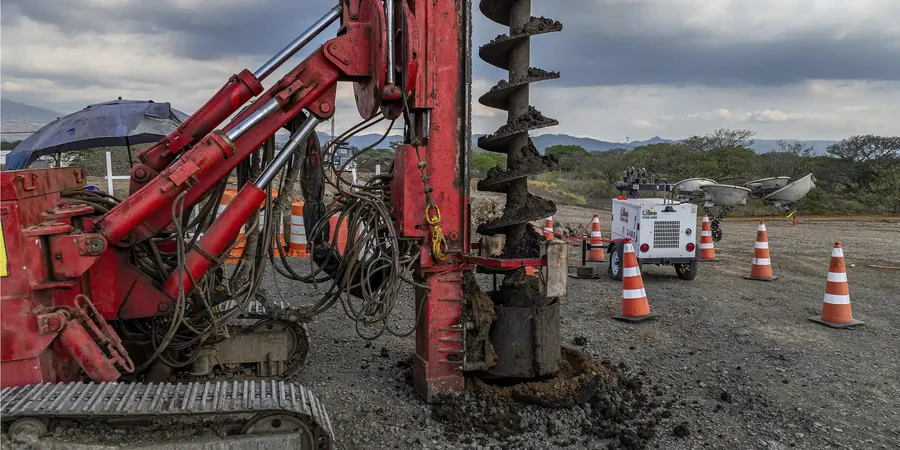
Typical technical challenges in Hamilton
NBCC 2015 Part 4 requires a geotechnical investigation for all buildings on compressible soils. Hamilton’s glaciolacustrine clays trigger this requirement. Skipping stone column design leads to excessive total and differential settlement. The risk is not just cracked drywall. It is broken underground utilities crossing the building footprint. We apply the Priebe method for settlement estimation. We cross-check with PLAXIS 2D axisymmetric models. Column failure by bulging occurs if the undrained shear strength drops below 15 kPa. In those pockets we tighten the grid. We also check bearing capacity of the column group. The composite friction angle often exceeds 38 degrees. Our reports include pre- and post-treatment CPT profiles. The data proves the improvement.
Our services
Our Hamilton stone column scope covers the full design-verify cycle. We do not just drop a generic grid. Each report has site-specific calculations.
Composite Ground Modulus Calculation
We compute the improved modulus from area ratio and modular ratio. Critical for mat foundation design.
Settlement Analysis (Priebe Method)
We estimate total and differential settlement with analytical methods. We validate with finite element models.
Load Transfer Platform Design
We design the granular platform bridging columns. The reinforcement prevents punching of the footing.
Post-Treatment QA/QC
We run MASW lines and plate load tests. The stiffness must meet the design modulus within 5%.
Frequently asked questions
What soil conditions in Hamilton justify stone columns instead of deep foundations?
Sites with 5 to 20 m of soft clay with undrained shear strength between 15 and 50 kPa are prime candidates. The columns transfer load through the weak layer to firmer till or bedrock below.
How is the stone column diameter and spacing determined?
We use the Priebe method and PLAXIS models. The diameter typically ranges from 0.8 to 1.2 m. Spacing depends on the target area replacement ratio, usually 10% to 30%.
What is the typical cost range for stone column design in Hamilton?
The engineering design package ranges from CA$1,810 to CA$6,190, depending on the number of column zones and the required verification testing.
How do you verify the ground has been improved?
We run MASW surveys and plate load tests before and after installation. The shear wave velocity must increase by at least 50% and the composite modulus must match the design value.